Slip and Fall Accidents in NYC: Proving Liability in Personal Injury Cases
Slip and fall accidents represent one of the most common types of personal injury claims in New York City. From icy sidewalks in Manhattan to poorly maintained stairwells in Brooklyn, these incidents can result in serious injuries including fractures, traumatic brain injuries, and spinal cord damage. Understanding how to prove liability in these cases is crucial for securing the compensation you deserve.
Understanding Premises Liability Law in New York
In New York, slip and fall cases fall under premises liability law, which holds property owners and occupiers responsible for maintaining safe conditions. Whether the incident occurs in Manhattan, Queens, The Bronx, Staten Island, Nassau County, or Suffolk County, the fundamental legal principles remain consistent throughout the state.
Property owners owe visitors a duty of care to keep their premises reasonably safe. This duty varies depending on the visitor’s classification—invitee, licensee, or trespasser—with invitees (such as customers in a store) receiving the highest level of protection under New York law.
Key Elements for Proving Liability in Slip and Fall Cases
1. Demonstrating the Dangerous Condition
The first step in proving liability requires establishing that a hazardous condition existed on the property. Common dangerous conditions include:
- Wet or slippery floors without warning signs
- Uneven pavement or cracked sidewalks
- Poor lighting in stairwells or walkways
- Debris or obstacles in walkways
- Defective flooring or carpeting
- Snow and ice accumulation
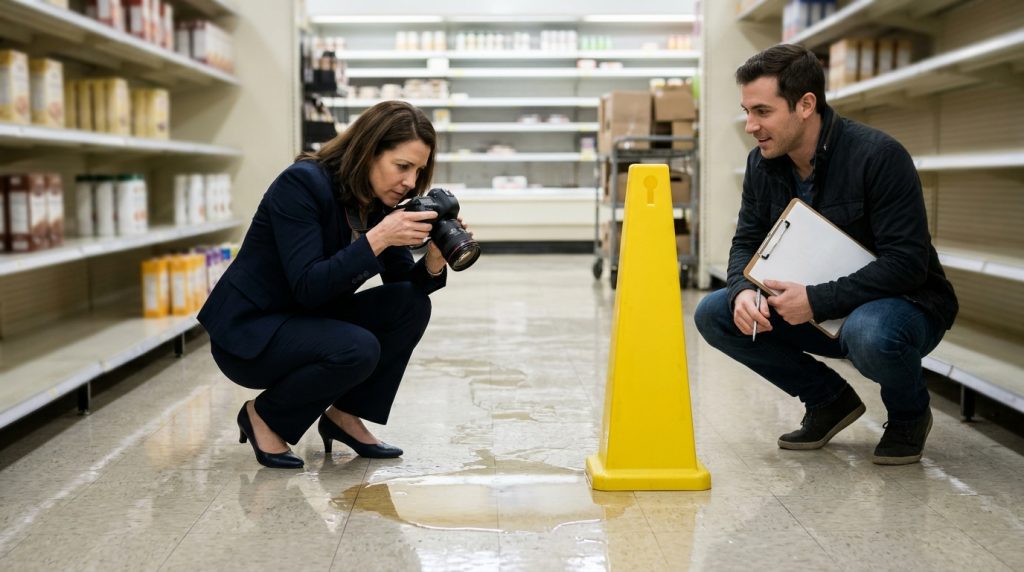
Photographic evidence, witness statements, and incident reports become invaluable documentation in establishing the existence of these hazards.
2. Establishing Notice: Actual or Constructive
Under New York law, plaintiffs must prove the property owner had either actual or constructive notice of the dangerous condition. Actual notice means the owner knew about the hazard directly. Constructive notice means the condition existed long enough that a reasonable property owner should have discovered and remedied it.
The “time-notice” rule is particularly significant in New York premises liability cases. Courts examine whether the hazard was present for a sufficient period that the property owner should have identified and corrected it through reasonable inspection procedures.
3. Proving Causation
You must demonstrate that the dangerous condition directly caused your injuries. Medical records, expert testimony, and accident reconstruction may be necessary to establish this causal link between the hazardous condition and your specific injuries.
Special Considerations for NYC Property Types
Commercial Properties
Retail stores, restaurants, and office buildings throughout Manhattan and other boroughs have heightened responsibilities for maintaining safe premises. Regular inspection protocols and maintenance records often become critical evidence in these cases.
Construction Sites
Slip and fall accidents at construction sites involve additional complexities under New York Labor Law. If you’ve been injured at a construction site, understanding your rights under scaffolding law and other construction law provisions is essential for maximizing your recovery.
Residential Properties
Landlords in Brooklyn, Queens, and throughout NYC must maintain common areas in apartment buildings. Stairwells, lobbies, and sidewalks fall within their maintenance obligations, creating potential liability when accidents occur.
Common Defenses Property Owners Raise
Property owners and their insurance companies frequently assert several defenses in slip and fall cases:
- Comparative negligence: Arguing you were partially at fault for not avoiding an obvious hazard
- Lack of notice: Claiming insufficient time to discover and remedy the condition
- Open and obvious doctrine: Asserting the hazard was so apparent you should have avoided it
New York follows a pure comparative negligence system, meaning your compensation reduces proportionally to your percentage of fault. However, unlike some jurisdictions, you can still recover damages even if you’re found more than 50% responsible.
The Importance of Immediate Action
Time is critical in slip and fall cases. Evidence disappears, witnesses’ memories fade, and New York’s statute of limitations—generally three years for personal injury claims—continues running from the accident date.
Document everything immediately: photograph the scene, obtain contact information from witnesses, report the incident to the property owner, and seek medical attention even if injuries seem minor. These actions strengthen your case significantly.
For answers to frequently asked questions about personal injury claims, visit our FAQ Videos page, where we address common concerns in easy-to-understand formats.
Why Legal Representation Matters
Slip and fall cases require sophisticated understanding of premises liability law, building codes, and insurance practices. Property owners and their insurers employ experienced defense attorneys who work to minimize payouts.
An experienced personal injury attorney investigates thoroughly, retains necessary experts, negotiates with insurance adjusters, and litigates when fair settlement proves impossible. Whether your case involves issues intersecting with criminal law (such as assaults in negligently secured premises), bankruptcy law (when property owners file for bankruptcy protection), or international law (for accidents involving foreign property owners), comprehensive legal counsel ensures your rights remain protected.
Contact Tini Law, P.C. for Your Slip and Fall Case
If you’ve suffered injuries in a slip and fall accident anywhere in Manhattan, Brooklyn, Queens, The Bronx, Staten Island, Nassau County, or Suffolk County, the experienced personal injury attorneys at Tini Law, P.C. stand ready to evaluate your case and fight for the compensation you deserve.
Don’t let insurance companies minimize your claim or property owners escape responsibility for their negligence. Contact Tini Law, P.C. today for a comprehensive case evaluation and learn how we can help you navigate the complexities of New York premises liability law.